Notes from the Field
For many years, Libretto has had a presence at AFP’s Fundraising Day in Boston. Sometimes we send a few Librettists to mingle, other times we share our insights via a presentation, and we always try to set up a table with information about our offerings.
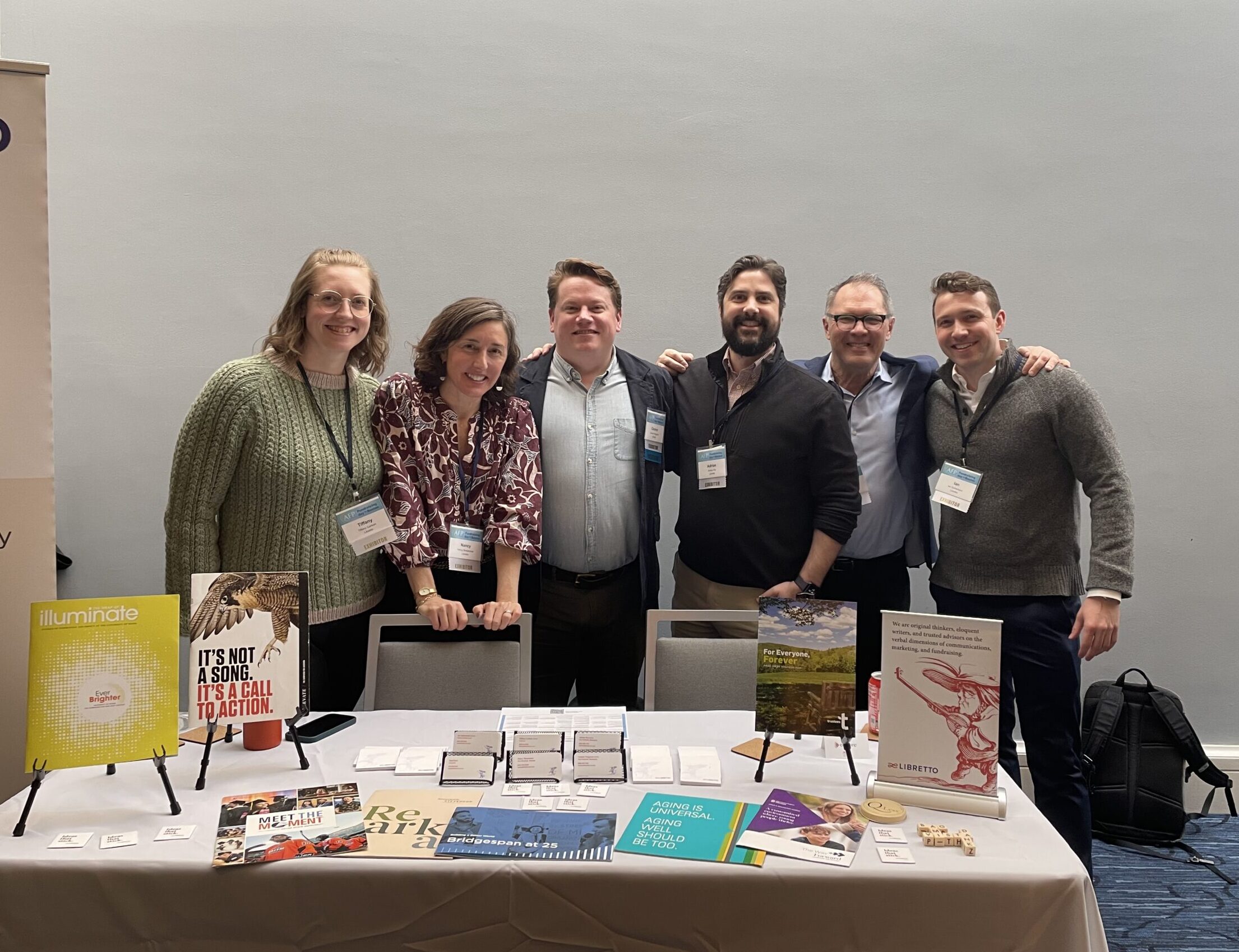
The event serves as a rewarding day spent with friends and colleagues old and new, learning about emerging trends, opportunities, and challenges in the fundraising field. This year, Libretto’s full team attended the conference, and we wanted to share a few of our takeaways.

Creating Confidence
by Tiffany
Fundraising Day is a day full of handshakes, introductions, and new faces. It’s a far cry from my day-to-day work in my Minneapolis home office, and a welcome reminder that we can all improve our skills when it comes to meeting new people, speaking up in public, and projecting confidence. Because of this, I was excited to see that one of the sessions was with Jonathan Allen, a public speaking coach who promised to make new interactions a little easier. He had some solid advice:
Allow time to breathe and speak. Become comfortable with silence. Try to remain grounded in the moment, because people can tell when you’re not.
All logical tips, and we might say, “Oh yes, of course, I knew that!”—but it’s easier said than done. Standing at a table speaking to someone, it’s easy to ask them about their work, but sometimes the mind wanders in search of a point of connection between the two of you. When you’re short on time between sessions, you may power through your spiel and talk a bit too fast. Sometimes, everybody just needs a moment to process what’s been shared, and what’s going to be said next.
My takeaway? Knowing something and doing something are two completely different things, and doing it gets easier with practice. AFP provided a wonderful opportunity to get out and flex my social muscles; it was a great reminder that intentionally practicing active listening facilitates genuine, attentive interaction.
From Crutches to Clarity
by Nancy
This year, the most resonant idea for me (among many) from Fundraising Day came from a panel hosted by Libretto’s own Connor Ferguson in collaboration with Jennifer Norris, Chief Development Officer from the Appalachian Mountain Club (AMC). During their fireside chat, they discussed Libretto’s work to create a public-facing strategic plan document that paved the way for AMC’s campaign communications. They also reflected on how organizations have tried to stay out of the crosshairs of an administration that’s openly hostile to DEI practices by stripping words like “diversity” and “equity” from their communications while still acting in accordance with their values. So many organizations have deleted statements they stand behind so as to avoid drawing attention that could lead to paralyzing budget cuts. But the panel raised the idea that there’s maybe a silver lining: “Using words like ‘equity’ or abbreviations like ‘DEI’ can be shortcuts that keep us from delving into what we really want to say,” Jennifer noted. “Having to really interrogate what we mean—and why we think it’s important to say these things—has led us to go into more detail and depth.”
Following the AFP conference, I spent a day of discovery at a Boston-area college that’s also grappling with this issue. It was incredibly uplifting to hear about the many ways that the work related to diversity and inclusion has continued with renewed urgency and energy—even while communications around that work has changed. We’ve all read about another on-campus DEI office being shut down, or noticed changes to a familiar nonprofit website. But we have to keep this in perspective: In most cases, that shift is a strategic one, made to ensure that the really vital work is able to continue unimpeded. The conversation at the AFP session reminded me that in the midst of so much news that’s disheartening and downright scary, there are so many people on the ground still doing the important work. And while it may seem paradoxical, no longer relying on shorthand or linguistic crutches gives us an opportunity to delve into mission and explain intent and outcomes even more clearly.

Another Tool in the Rhetorical Toolbelt
by Connor
I enjoy learning new tricks and formulas for writing and telling stories, not because I rely on formulas, but because having an arsenal of these structures can help jumpstart your creativity when faced with a blank page. What’s more, structures and formulas for building a narrative often persist for the simple reason that they’re surprisingly effective at engaging listeners or readers. Half the fun of learning a blueprint for a story or presentation is recognizing examples you’ve encountered in the wild that follow it—or realizing you’ve already used something very similar without realizing it.
Public speaking coach Jonathan Allen gave a great example of a structure for building a persuasive speech or presentation. First you start with a hook: give your audience a reason to stay (or keep reading). Then offer an insight: what you want your audience to understand. Follow that up with a story, which proves the insight. Sum it up with a clear takeaway that demonstrates what should change as a result of this insight. And finally, a closing that serves as a call to action and gives the audience their next step.
I don’t expect that Jonathan was advocating for an unwavering adherence to this formula in every speech or presentation, but at the very least, I find these five elements to be helpful reminders of what makes an effective piece of persuasive writing or speaking. Maybe I’ll use a version of this the next time I have to give a presentation, or maybe I’ll choose a few of these structures and subvert or play with others. Either way, it’s good to have another tool in my rhetorical toolbelt.

Mission Over Money
by Neal
Attending this year’s Fundraising Day reminded me of the inherent benefits of an IRL event, which encompass not only interactions that are personally and professionally rewarding, but also the rewards that come with being able to catch up with a number of folks (and make new connections) in a single day.
One of the panels I attended, which focused on navigating today’s fundraising climate, featured Jennifer Chrisler (President of Hampshire College), Dallas Ducar (Executive VP of Donor Engagement and External Relations at Fenway Health), and Theresa Ulrich (Director for Development and Advisor for Science Partnerships at the Broad Institute). Having written about the challenges facing our clients in the present moment, it was interesting to hear how different individuals and organizations are negotiating that landscape. Hampshire had been through a long and well-publicized period of financial struggle; Fenway Health was addressing funding challenges associated with current Federal policies around research and LGBTQ+ advocacy; even the Broad, which is exceptionally well-funded, wasn’t immune from the repercussions resulting from MIT’s uneasy relationship with the current administration.
One of the things that struck me about the discussion, which focused on topics such as the importance of maintaining a supportive organizational culture and the willingness to address one’s individual sense of vulnerability, was its egalitarian nature. There wasn’t a sense of “haves” and “have nots”; each individual demonstrated a deep commitment to advancing their organizational mission in ways that transcended fiscal considerations. Their embodiment of philanthropy in its literal sense—love of humanity—affirmed my belief that the best fundraisers have an authentic desire to shape a better world. While they need to ground their work squarely in reality, their enduring motivations are both altruistic and idealistic.
A sad postscript: Several weeks after the conference, it was announced that Hampshire College will be closing its doors—a sobering reminder that none of the organizations we serve are immune from the market forces, evolving demographics, and shifting perceptions affecting both higher education and the nonprofit world.

Only Connect
by Adrian
As Libretto continues to establish a presence at venues like AFP, it’s been gratifying to run into current and former clients, or have the chance to speak with folks at organizations whose names and work have come up in other contexts and conversations—essentially, reinforcing the existing nodes of my network rather than solely sparking new ones. Casual gossip and inside jokes do not a career make, but they are vital to the human relationships at the core of successful brand-building. I was thrilled to run into several former partners to learn about their current work, and what so-and-so is up to these days, and gosh did you see how things turned out with such-and-such organization?
One of the refrains of AFP Boston 2026 was that fundraisers are burning out at an astonishing rate. Treating conferences and other communal experiences as an opportunity to foster positive human connections—rather than just to learn about the hot new app or close the big deal—goes a long way toward building the positive emotional resilience and foundational web of support that allows one to weather challenging circumstances. As Taylor Swift would tell you, it’s nice to have a friend.

Ask the Question
by Ian
When attending a presentation, it can be daunting to ask that first question in a room full of strangers (especially before the coffee’s fully kicked in). But early on during Chuck Gordon’s talk on how to cultivate a board’s culture of philanthropy, I tossed up my hand. Chuck was asserting that every member of an organization’s board should be able to raise funds; as Libretto has worked with many boards through various campaigns, I was a little taken aback. “What if it’s a young, brand-new trustee?” I asked. “Isn’t it valuable for an organization to have their perspective, even if they’re not financially able to contribute?”
“Yes,” Chuck smiled, anticipating my question. He went on to explain that every board member’s fundraising capability includes being able to identify new prospects from their network, introduce leadership to potential funders, and engage existing donors. Quoting Les Brown—“no one rises to low expectations”—he prompted me to think more deeply about how Libretto communicates our messaging work to trustees, especially when we hope to inspire their active engagement during a campaign.
As an extrovert, I always enjoy AFP as a networking opportunity. It’s a chance to meet great people, share stories, and yes, bask in some positive affirmation about our profession. But it’s also an opportunity to ask questions, then go back to work having learned something new. Beside’s Chuck’s presentation, I attended a talk by Meg George from George Philanthropy, a Libretto partner, who gave a thought-provoking presentation on how to approach major gift solicitations. I’m grateful to Chuck, Meg, and all the folks who spoke at AFP this year (including Libretto’s Connor Ferguson), and I’m looking forward to AFP New York this summer, where, yes, you’ll probably see me with my hand up to ask a question or two.